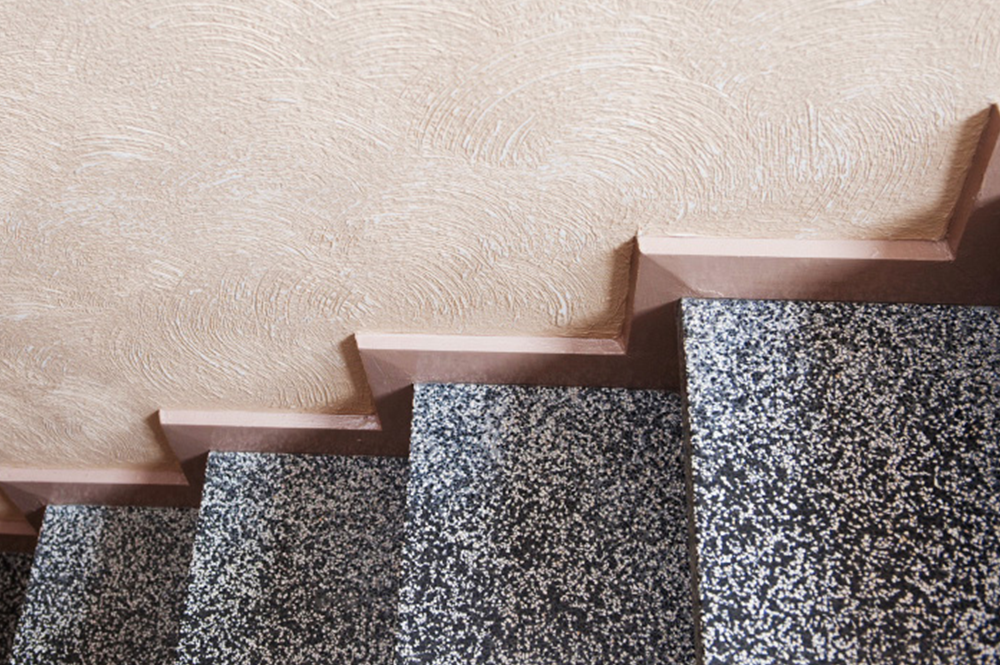
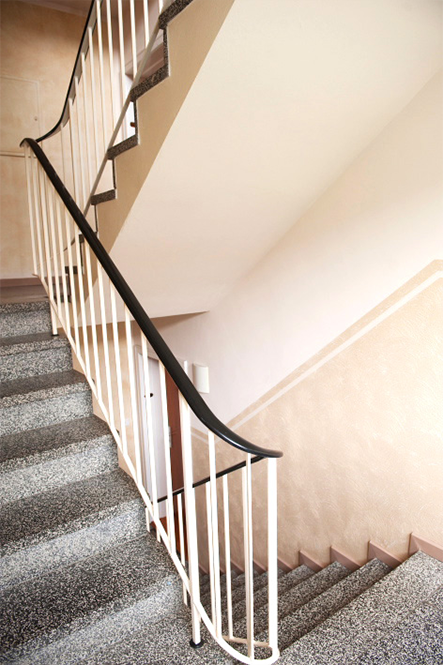
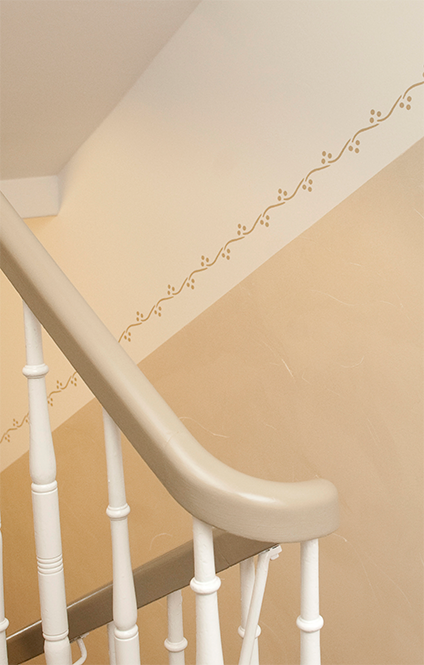
Some of the corridors in our housing stock date back to the 1930s and are furnished with durable materials. There are, for example, terrazzo floors and stairs, wooden skirting boards, metal railings with plastic handrails or wooden railings with turned rungs and, of course, the often beautiful old entrance doors. Over the decades, both the terrazzo floors and the railing designs have certainly gone out of fashion several times. However, hallway renovations in a comprehensive style, in which both the floors and the walls are renovated from the ground up, are not affordable and cannot really be justified, as the material is extremely durable. For this reason, it is all the more valuable that our colleagues from the painting department are so willing to experiment and refurbish and stage the conditions in the best possible and tasteful way. A well-preserved terrazzo floor, for example, can be given a new lease of life with the appropriate wall design and lend the hallway a special touch - as the photos impressively show.
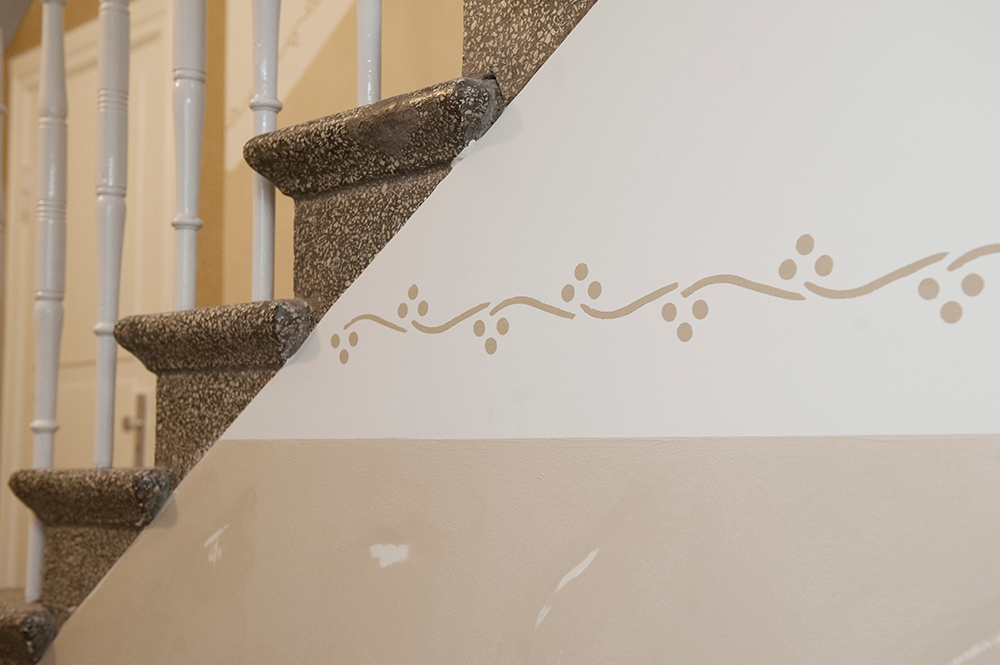
The large old wooden coffered doors also exude a special charm - especially if they have been professionally and sympathetically refurbished. "Such renovations are labor-intensive," says master painter Mike Thomsen. "In the house at Vogtstraße 39, for example," he explains, "we tried to combine the old style of the house with borders using the stippling technique with new components, such as hammer finish paint. As can be seen in the pictures, the heating and drainage pipes that lead to the basement and are visible on the first floor were not "painted away" in the color tone as in the past, but were deliberately set in scene. Master painter Thomsen explains the individual work steps: "First, the wall in the plinth area is filled with a wallpapering sheet (also known as a 'flyer' in painting circles). In the second step, the paint is applied and finally the 'grade' is sanded down a little. This creates a lively and interesting texture. To protect it from dirt, the plinth area (which - as was customary in the past - was raised higher than normal) is given a transparent finish." Once the upper area had been smoothed and painted, the colleagues then stippled a border in a matching color - just like in the 1950s. These works of art have now almost completely disappeared from the stairwells. "It was a bit of a challenge," smiles Mike Thomsen, as the stippling technique is unfortunately being used less and less these days. It's an unusual practice and, of course, it's always interesting for our trainees to learn how such old craftsmanship techniques are carried out and then to help design them." The photos of a hallway in Waldstraße clearly show that a simple metal banister, painted in this color, can be seen again with the right surroundings.
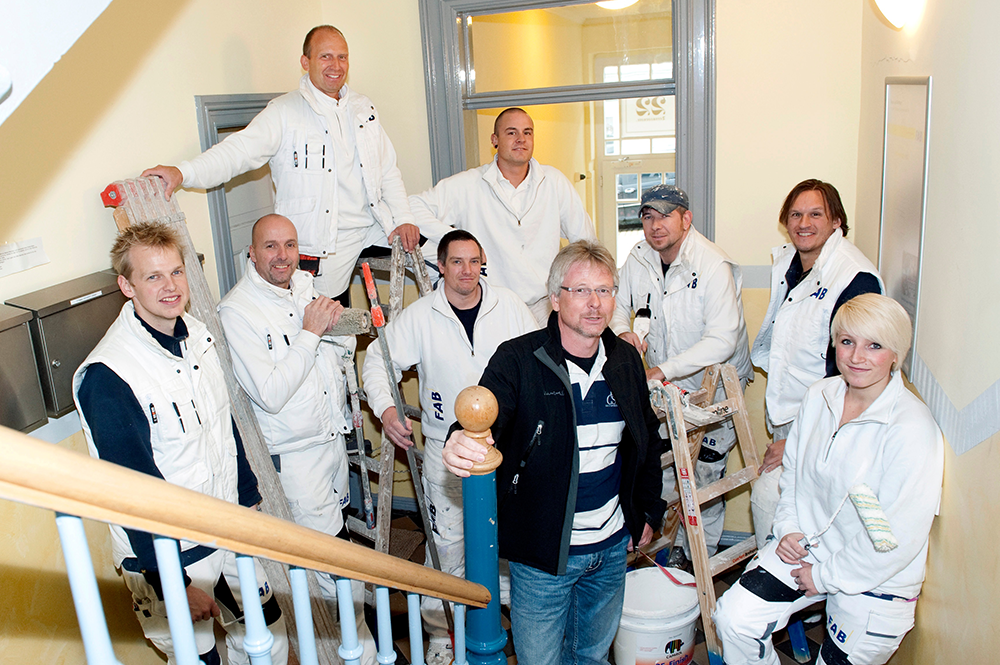
The wall covering itself is the matt plastic that has already been mentioned several times. With this basic material, our painter colleagues then try out various wiping, plastering and filling techniques from time to time - everything that is possible. And if the master painter at Farben Sörensen has also found an unusual brush, a special but very attractive "FAB scratching technique" can be created. When our painting team leaves the house, the hallway appears in a new light: ceilings, walls, skirting boards, doors and banisters - professionally finished with attention to detail.
Many thanks to our master painter Mike Thomsen for the detailed insights into the world of painting and to Ms. Lins for the beautiful property photos and, above all, many thanks to our colleagues in the painting department for the many beautiful and special hallways in our housing stock.